
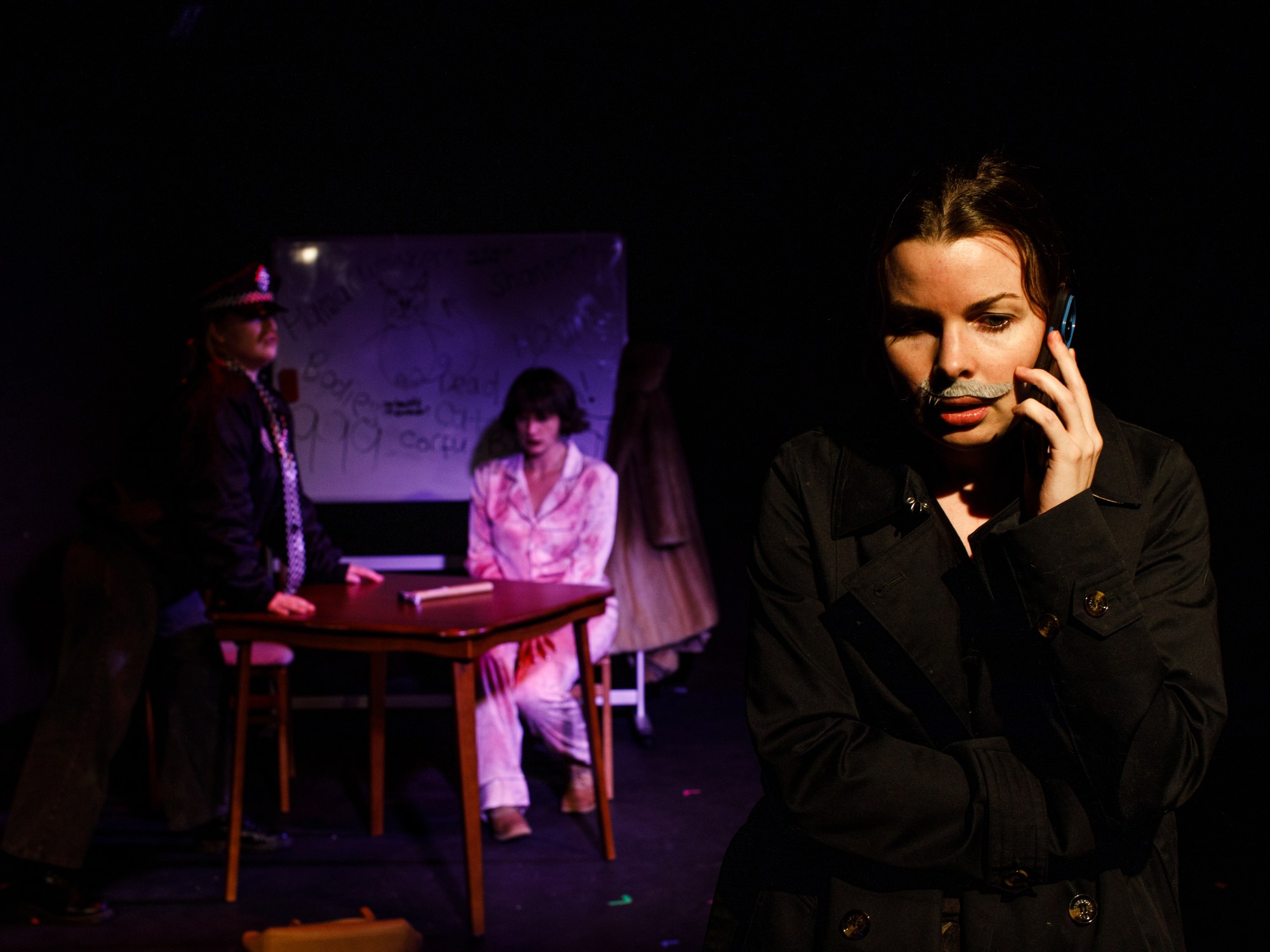
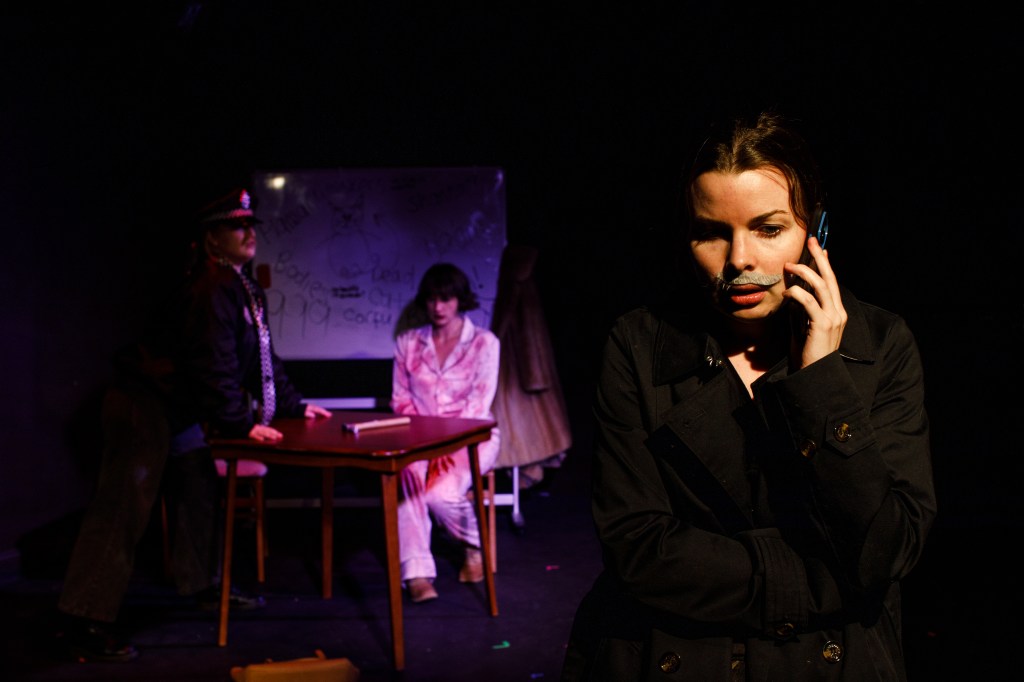
How Not to Fund a Honeymoon is a tale of two plays. One of them has the opportunity to be very funny and the other never rises above filler. It seems to only exist because Stephanie Greenwood did not have enough material for a one-hour show. The quality part of the show involves Charlie (Claire Feuille), Gwen (Tabitha Bradley) and Aunt Robyn (Stephanie Greenwood). The “poor sister” show has Feuille shifting to the role of Detective Inspector Williams and Bradley as Officer Nicky with Greenwood remaining Aunt Robyn.
The premise of the primary show is that a young, entitled couple is fueled by a “need” to have a first-class wedding and a honeymoon in the Seychelles. That entitlement, combined with a lack of and underemployment, leads the young couple to the idea that they should burgle the recently widowed Aunt Robyn who is rumored to have secured a mystery treasure somewhere in her mansion. The couple, being at the top of the intelligence scale, wonder if Robyn will notice if they gain entrance by using a rock to break a window. What they choose to ignore is that there are strong indications that Robyn may have “hastened” her husband’s death through the use of the “proper” medicinal enhancements. When she confronts the ambitious young couple Robyn has little hesitation in using her firearm to dispatch the home invaders.
The primary show (properly referenced since the show slips back and forth between the primary and secondary tales) screams for expansion. Why are Charlie and Gwen not, in 2026, completely enmeshed in the need for Social Media acceptance? Why isn’t their failure to get financially rewarding employment explored as a source of their entitled frustration? Why isn’t Robyn’s mystery treasure given a reveal that would make Charlie and Gwen’s quest even sillier? Why aren’t the death of Robyn’s husband and her homicidal narcissism made into a central theme?
Greenwood would probably answer that she wanted to avoid using conventional tropes. But she needs to realize that tropes move stories forward because they do not only occur in fiction, but also in life and are automatically recognized by an audience.
The bumbling police procedural part of the show did not serve the play well. The young cop whose “bungling” is more a lack of respect for her “betters” rather than a lack of competence and a Detective Inspector who backs down whenever challenged by the rich suspect. A call for Robyn from King Charles automatically ends any investigation into Robyn’s involvement in the young couple’s death and certainly would not allow an investigation into her husband’s “natural” death from poison. Greenwood never does establish any ties between the police procedural half of the play and home invasion. The slapstick police procedural with unexplored social commentary makes this part of the show disconnected and disjointed. It starts and ends devoid of both.
If only the audience could have learned “how not to fund a Honeymoon”. Should Greenwood acquiesce to providing that information, she would have a fine comic play.

