
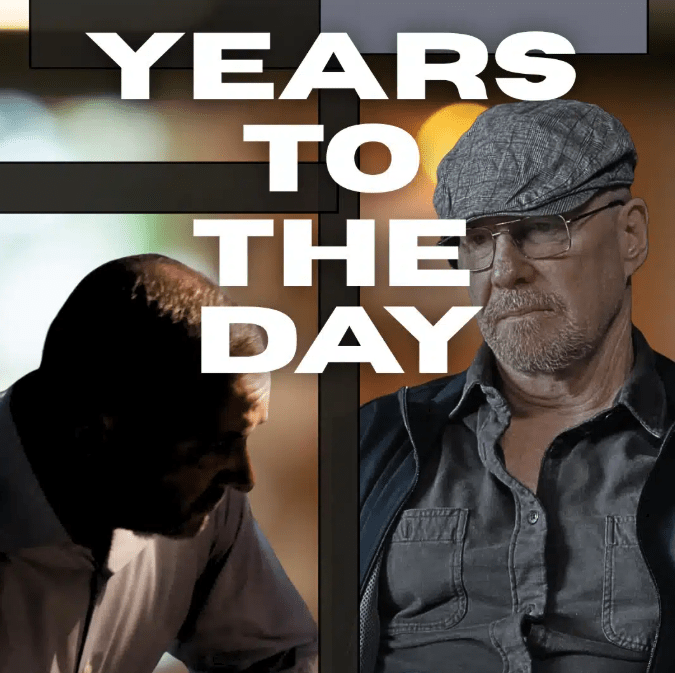
In an era of relentless digital “content,” where the human experience is often reduced to a series of notifications and algorithmic feeds, Allen Barton is staging a quiet revolution. It’s a revolution built on a deceptively simple foundation: two people, one room, and eighty minutes of uninterrupted honesty.

Barton—a Los Angeles-based playwright, director, and Steinway Artist—has spent over three decades at the helm of the legendary Beverly Hills Playhouse (BHP). Having inherited the mantle from his mentor, Milton Katselas, Barton has dedicated his career to the craft of acting. But it is through his own writing, specifically his most traveled play, Years to the Day, that he explores the “tectonic drift” of modern adult friendship.
From Breakfast to the Boards
The genesis of Years to the Day was as organic as the play itself. In 2012, Barton sat down for breakfast with his long-time friend, actor Jeff LeBeau. Noting it had been exactly four years to the day since their last meeting, Barton watched as their conversation careened through the heavy lifting of middle age: marriage, kids, health, and the increasingly polarized landscape of politics.
“At some point, I noted that what was happening over this breakfast could make an interesting premise for a play,” Barton recalls. “Two friends get together after years and wonder whether they’re still friends.”
The play became an experiment in dramatic minimalism: could a single, real-time conversation sustain the weight of a professional production? The answer was a resounding yes. Since its 2013 premiere, the play has crossed three continents and two languages, proving that the anxiety of losing touch is a universal human condition.
The Age of Adaptation
Thirteen years after its debut, Years to the Day is undergoing a fascinating evolution. Originally written for characters in their early 40s, a recent production in Pittsburgh necessitated a shift. The actors—Dihlon McManne and David Whalen—read more naturally as mid-50s. Barton adapted the script, “rewiring” the ages but leaving the core themes untouched.
The result was a revelation.
“I was watching a play that didn’t so much remind me of my early 40s as it did mirror my current life, in a more worn frame,” Barton says. This “age bump” added a layer of gravity to the dialogue. When you are 55, the stakes of a drifting friendship feel less like a temporary lapse and more like a permanent loss.
This new, matured version of the play is now returning to its home at the Beverly Hills Playhouse, featuring Jeff LeBeau—the original inspiration—revisiting a fictionalized version of himself, opposite Peter Zizzo as Dan.

Theatre as the “Real Thing”
Barton is candid about the state of modern connection. The play opens with a debate on whether social media has become a substitute for reality—a substitute so pervasive that we eventually forget what the “real thing” even looks like.
“The form of live theatre itself… that to me IS the real thing,” Barton asserts. “And yes, we’ve lost it. We’ve forgotten what it is.”
By stripping away the bells and whistles of modern stagecraft, Barton forces the audience to engage with the “quiet” that only the theatre can provide. It is a space where the right side of the brain argues with the left for 80 minutes, and where the audience is invited to witness the friction of two lives colliding after years of silence.
The Road to New York and Beyond
As Years to the Day prepares for its New York run, Barton remains focused on the power of the story. While critics often compare the work to the talk-heavy classic My Dinner with Andre, Barton sees it simply as a testament to character and care. If the audience cares about the people on stage, eighty minutes feels like a heartbeat.
As for what follows this revival, Barton is looking toward a different kind of tension. Between managing the BHP and raising three children, he has spent his recent years diving into the complexities of the global banking system.
“I’ve gone down a rabbit hole on money, how it works, and how it all seems to be falling apart,” he says. “I feel that having done all this research, I should talk about it somehow. That will probably be the topic of my next play.”
Whether he is dissecting the mechanics of a friendship or the mechanics of the economy, Allen Barton’s work remains rooted in a singular pursuit: finding the truth in the noise.