
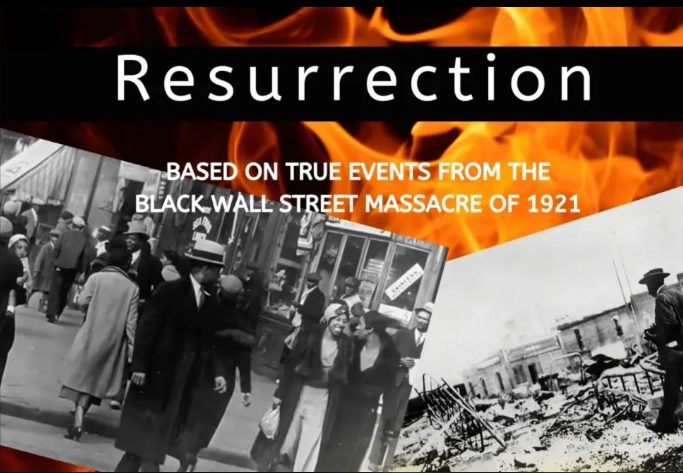
In Resurrection, Anne L. Thompson-Stretching gives us a play that tells us why historical fiction often gives a clearer path to understanding history than historical research is able to provide. Imagining what people did, how they lived their lives, what effected their thinking and why they did what they did gives us insights that actual, less than definitive, research cannot and should not speculate on.
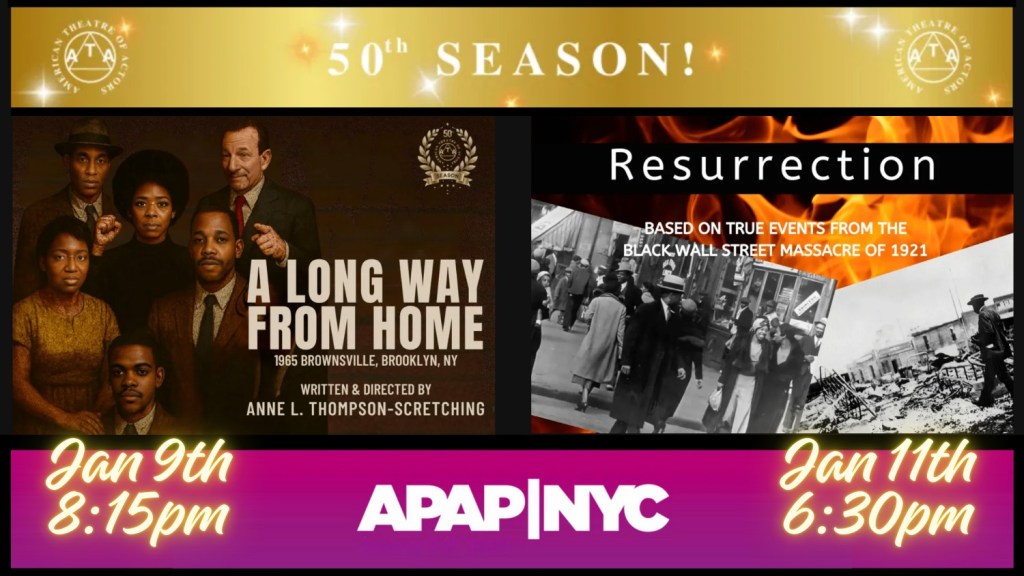
The 1921 Race Riots in Tulsa, Oklahoma have been consistently overlooked in the history of the United States and whether the dead numbered in the 30s or the hundreds there is no doubt that an entire thriving area of an American city was systematically destroyed by citizens pretending moral outrage while really concerned with the economic inferiority their get rich quick schemes, exploitation by speculators and lack of education visited on them. A thriving Black population in Tulsa provided the perfect target to express whites’ frustration with little fear of reprisal.
Thompson-Stretching freely admits that every character comes from her imagination – an imagination informed by her research into the massacre. That gives the characters a life that a “real” history would lack and gives the audience insight into life in a midwestern boomtown in the early part of the 20th century.
The first act is an exploration of relationships in the Black business community from the “passing“ lawyer, the realtor, to the bootlegger (Peter) who Thompson-Stretching assigns the role of a Shakespearian “fool”. Peter appears a little off-balance and on the outside of the community but has more and clearer insights than any other character. The first act, of course, was the more difficult one to write. No matter how much insight into human behavior Thompson-Stretching might have, the means of raising capital and obtaining goods, especially for a Black man or woman in 1921 is something that none of us really understand. As a result, the first act does not provide much insight into the economic tension that must have accompanied the racial tension always faced by Blacks in Tulsa.
The second act is where Thompson-Stretching really soars. As she does in her Blood Trilogy, she shows her knowledge of what racism and poverty looks like and the violence it invites. She brilliantly engages the audience by putting both on stage. The audience must confront the discomfort of racism run amuck and the brutality that accompanies it.
The second act begins with “Blue”, perfectly captured by Travis Bergmann, and “Poke” (Jon McHatton) confronting “Peter” (Kevin Leonard), the bootlegger, when he crosses the tracks to bring them their standard order of moonshine. Blue embodies all the things that white trash is, was, and always will be. The danger, always under the surface, rises throughout the long scene as he eventually “guts” Peter and forces Poke to help him hide the body. Joy Foster’s Bess, facing death for herself and her baby from the Klan inspired mob, kills her baby rather than let it fall victim to the rage of the white murderous invaders. Katie Trubetsky fully embraces the role of town “bike” (Lula) whose “rape” serves as the excuse for the white rioters. Her over-the-top performance is perfect for the role Thompson-Stretching assigns the character and she, like Travis, goes places that most white actors would refuse to explore.
Although Resurrection is not perfect, it is still an essential watch for education and recognition of how far society still has to go to deal with its projected, misplaced rage at its problems.

