
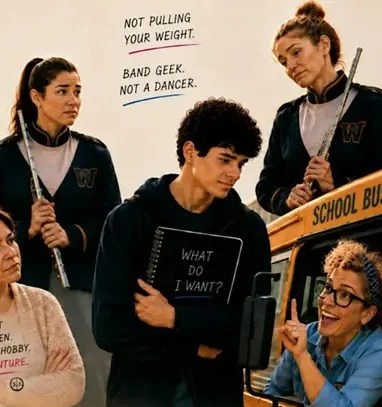
The problem with Inside Out, as currently written, is that the plot is outside in. Each of the supporting actors acts upon “Ben” as he tries to find himself as an awkward teenager. Each of the supporting roles is more interesting than the protagonist’s life.
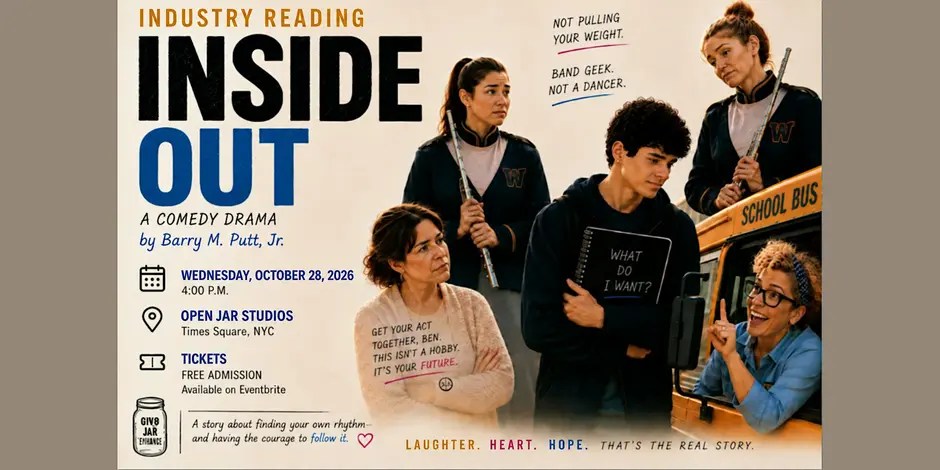
“Ben’s mother” is driven by the idea that Ben needs a better education and better opportunities than she had. The audience is eventually suspects that Ben’s father is much the same as his mother. Although we first think that he is an important engineer sought after to trouble shoot international projects, we later suspect that he is a very much in demand mechanic to needed to fix US infrastructure purchased by foreign companies and governments. His mother is very aware of her lack of higher education and has an insatiable need to compare herself to her co-workers and friends and their children. She reveals her ignorance at several points in the play. She thinks that band participation will be a better way for Ben to get into a good college than dance but the schools she wants Ben to apply to don’t have marching bands (they all have dance programs). She identifies a business degree as prestigious as or more prestigious than pre-med, engineering, or computer programming. She even thinks of Warton a small school with a good business program. Her helicopter parenting, no matter how well intentioned is sure to send Ben in the wrong direction.
Ben’s bandmates, Missy and Valerie, are Ben’s mild bullies. They voice frustration in Ben’s apparent lack of musical skill and really wish he would disappear from their band lives. They also view themselves as academically and socially superior to Ben and seem to wish he would either know his place or improve himself.
Evan is the friend who brings confusion and opportunity into Ben’s life. He is the new kid in school and really into dance and the struggling dance club. Putts seems to imply that there may be some sexual attraction, but deserts that idea, choosing instead to Evan encouraging Ben to defy his parents and take risks that display Evan’s coping mechanism for the abuse his artist mother has always subjected him to. The friendship may be real, but it is more for Evan’s well-being than Ben’s benefit.
Karen is the driver of the late “activities” bus (not sure they exist anymore). She serves as the comic relief and person who defies all rules. She encourages Ben to be himself but does that by suggesting that he be more like her and live life acting on impulse.
Even the Band Director and Judge of the Dance Tryout seem to embody more interesting back-stories than Ben displays.
By putting the supporting characters on stage, Putt has created a situation where we know more about them than we do about Ben and where we are more interested in any of their stories than we are in Ben’s story. If Ben were left to tell his own story, standing alone on stage, we would learn much more about who Ben is and his internal trials and tribulations. Putt’s play right now seems to a very safe children’s play and very safe children’s plays are not even very interesting to children. If Putt discovers who Ben is and puts that on stage, he may be able to reintroduce some or all of his supporting characters, but right now the least important character in his play is his protagonist.

