
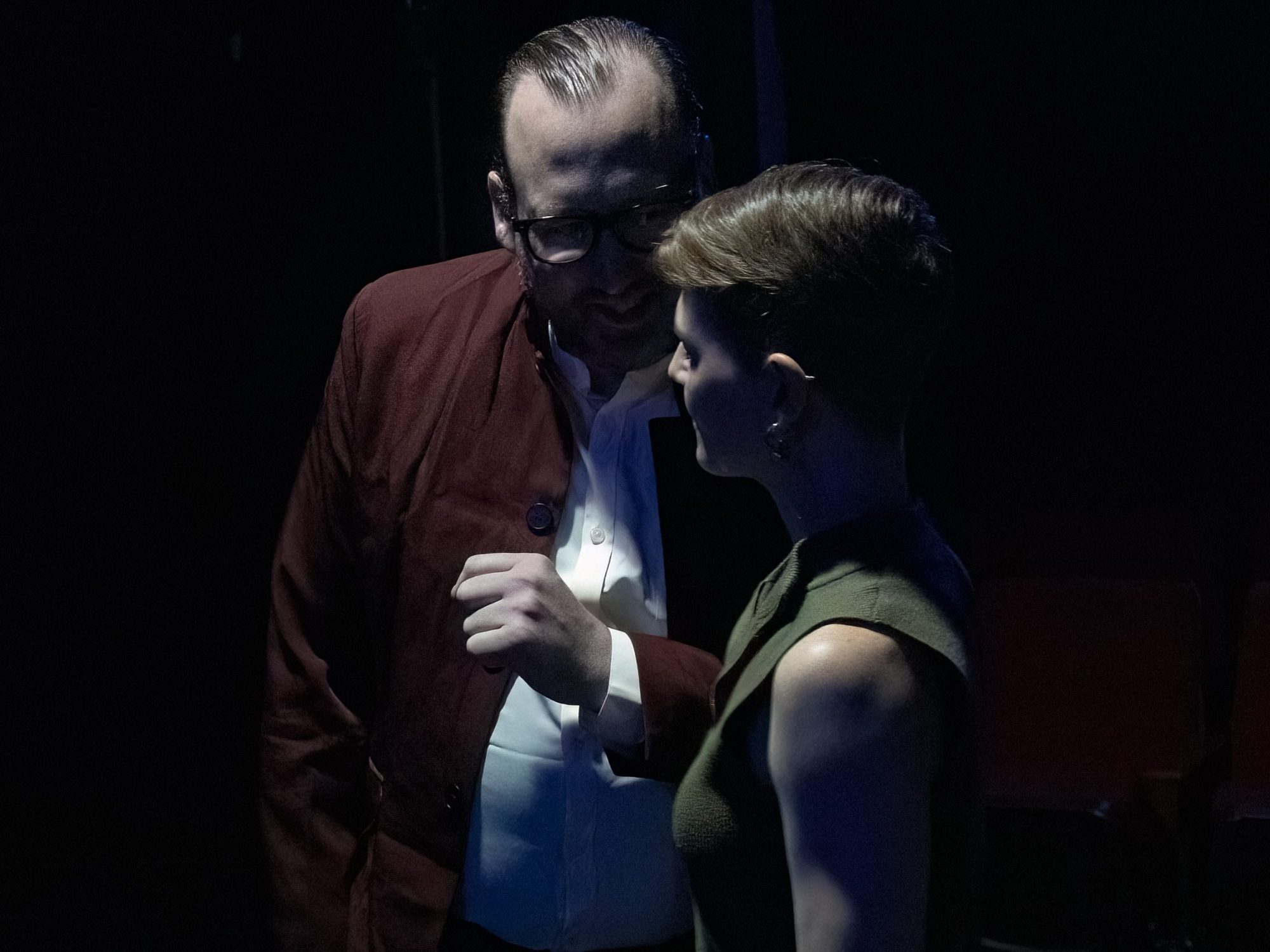
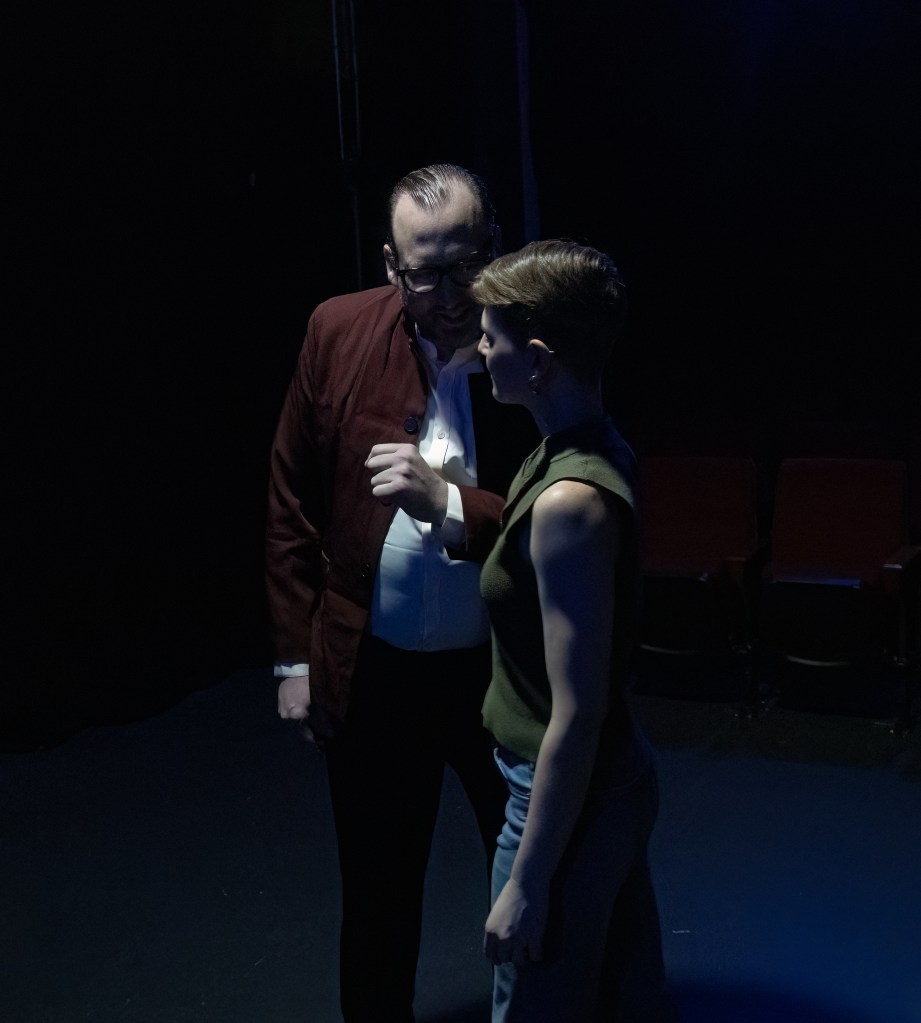
Anne of a Thousand Faces has the bones of a very good play. A contemporary story of Anne Boleyn where Anne directly challenges Henry in a bid to save her life makes for compelling thought. The current play and production, unfortunately, has problems that keep it from rising to its full potential.
The first problem is that Gibbons-Brown has failed to give the audience a viable hook to start the show. That currently leaves the audience disconnected after the first two or three scenes. Luckily Gibbons-Brown has the solution within the current show. He needs to move the digital epilogue (which will retain its place in the show’s conclusion) to the beginning of the show. That video will set the tone of the show and create a context for the production that will relieve the floundering opening of the current production.
Second, the show needs to recognize that there are at least two fully developed plot lines that run consecutively, rather than concurrent, with each other in this production. They actually do dovetail seamlessly into each other, but they would be much better if Gibbons-Brown expanded the show to introduce both of them early and create concurrent plot lines that help support each other instead of existing independently. These full scenes would also be placed prior to the current opening scene and continue as an undercurrent in the balance of the show.
The final problem is one that a relatively low budget show may not have that much power to correct. The black box of the ATA’s Beckmann Theater is a wonderful space that many directors have done wonders with, but it is a very poor space for this production. Anne relies as much on projections as dialogue to succeed and the Beckmann is the only one of ATA’s three theaters to not have a projection screen available. As a result, much of what is the importance of this show’s projections is lost as they become difficult to read and thus work more as a throw-in rather than the essential part of the production that they are.
The stories are very, very relevant and when done properly should excite audience members. The basic, primary plot is that “Playwright” (Edward Gibbons-Brown) is a billionaire who has become a dominant force in theater and film by stockpiling a large group of theaters and studios and financer of major productions. “His” current project is a play set on the eve of Anne Boleyn’s beheading. It adopts an ahistorical position that Henry will come to Anne and give her a chance to secure her life. Henry and Anne (Bonnie Lawrence) improvise scenes that might convince Henry to allow Anne to survive. Each improvisation will be judged by Playwright’s AI program. Each of the first four attempts, when Anne tries to convince Henry to spare her, still result in her beheading. On the fifth try, Anne moves to dominate Henry and as a result Henry loses his head. In the first plot, Gibbons-Brown deals with the power and misogyny that made Anne’s death inevitable once Henry decided it was necessary. Only when Anne grabs power does Henry lose his head and, more importantly, the support of the AI.
That is the essence of the second plot. For it was not Playwright that wrote the play, but AI, and it was AI that was responsible for all of Playwright’s wealth and power. Once Playwright failed AI, he became disposable and everything he had accumulated is quickly taken from him, including the support of his assistant, Chamberlain (Jasmine Jade Binder). The second plot warns that even those who use AI to gain wealth and power will become disposable once they fail to do AI’s bidding. It is a powerful message, even if not fully developed here.
Anne of a Thousand Faces should be seen, even with the significant flaws that mar this production. Everything wrong here can relatively easily be fixed and give this show the opportunity to become an important piece of theater.

