

Whatever is, for the most part, a really well-written piece by Scott Brooks with exceptional acting. Exploring the interactions of a quartet of damaged individuals in a suburban neighborhood is very well done. “David” (Sinclair Mitchell) is a pilot who served two tours where he was shot down and can hardly fly because of PTSD. He has taken a job as a private pilot who is constantly on call but is never asked to fly. His wife, “Luna” (Olivia Miller) is a former Miss Oklahoma who now is a successful influencer, marketing coffee enemas for health. She is obviously insecure about her attractiveness. “Cooch” (J. Richley Nash) is a former baseball player who dropped a ball because of fan interference in a World Series Game. That play would have ended the game and the World Series. He was attacked and ostracized by the media and fans. He now is a college assistant coach that hates his job and his life. He is an alcoholic and jealous of everyone around him including his wife. His wife is “Chrissy” (Julia Atwood) who has an amazingly successful YouTube Children’s show and a successful career as a children’s author. She feels demeaned by her children’s show and cannot stand “Cooch’s” failures and projections. She is having an affair with “David”. The odd person out is “Ruby” (Monica Ho). She is the assistant and co-founder of David’s billionaire employer’s business. She is eventually portrayed as a victim of her co-founder’s misogyny although it is hard to imagine her a victim of anyone – man or woman.
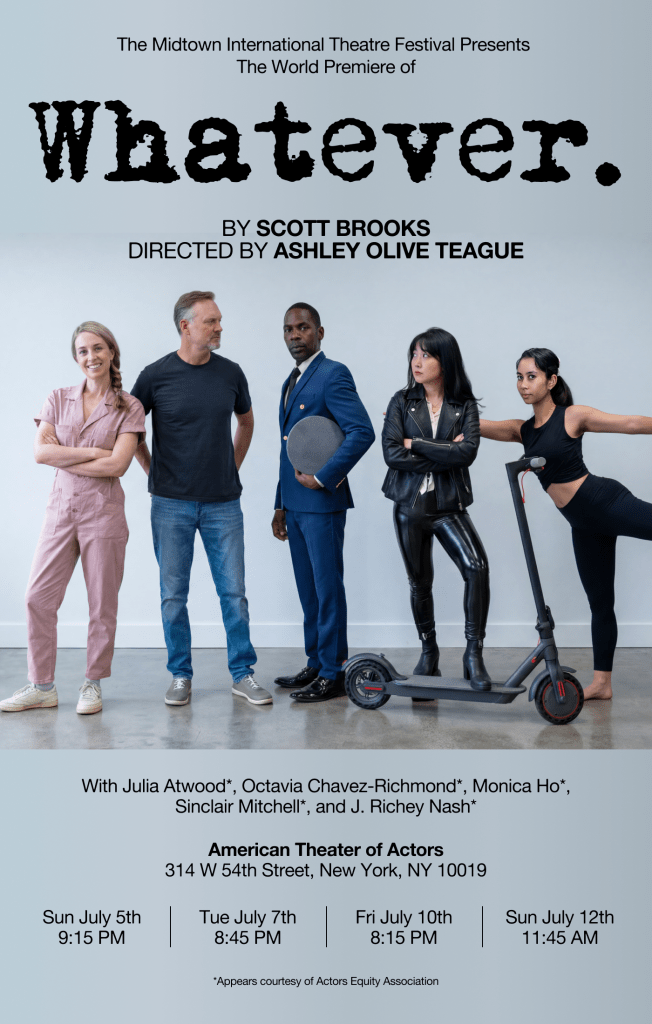
Atwood wisely keeps David’s billionaire employer off the stage, where all antagonists belong. Where he comes up a bit short is that none of his characters are the type of individuals who easily slide into the role of protagonist. He unsuccessfully tries to shoehorn David and Ruby into that hole by giving them roles where they might be the world’s saviors. The billionaire has created an AI in his own image that has been released into the world and cannot be stopped in its drive toward world domination. David gets the call to take the billionaire on the first flight of his employment, and he goes despite being told that a group of ecoterrorists were going to shoot the plane down. His suicide really does not make him a better person, just a person with some decency.
But Brooks hardest turn is forcing Ruby into the role of “good guy”. It is a false narrative tale of how women will rescue the world from the evil of men. The “rehabilitation” of Ruby never rings true. Her desire to stop the monster her co-founder created seems more from necessity than actual commitment. Giving her an earlier turn might make her more acceptable as a protagonist.
Where Whatever was not served well was with Ashley Olive Teague’s direction. She has done number of works with significant budgets that have been well-received. But she seemed unprepared to make Whatever work in the constraints of a festival setting. Despite getting fine performances from the whole cast and yeoman’s work from her stagehand, she made the set much busier than it needed to be. She often went to black and slowed the show to have a prop unnecessarily change position. Despite the stagehand’s excellent efficiency, the few seconds that it added to each scene change weighed on the play’s continuity. She could have accomplished virtually every scene change by a two or three second going to black and having the characters in the next scene be on stage. Lighting could have accomplished everything she tried to do with furniture.
Despite the current shortcomings of Brooks play, Whatever is still a well-written play that needs some tweaking to become a very entertaining work with a social and political message. Whatever should have a future, but it current form cries for some revision.

