
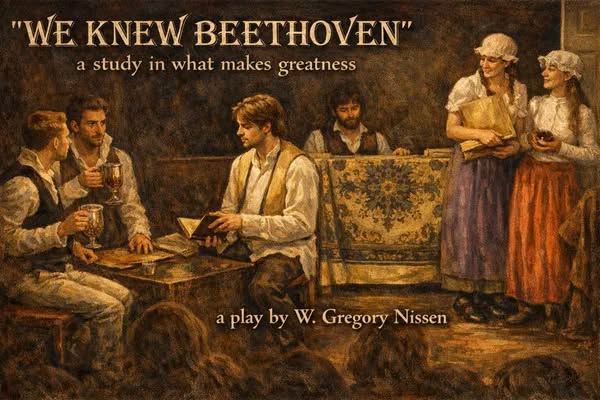
W. Gregory Nissan’s We Knew Beethoven, according to the author, has been a love project begun over 20 years ago. The base idea is interesting and has the opportunity of success. That idea is to trace Beethoven’s life through the people who knew him from when he was a young boy through his death. It is territory that has been sometimes successfully negotiated by other authors in trying to get behind the thoughts of other famous men. But, just as often, the attempt fails. It is difficult to develop fictional dialog for friends and family unless you know who those friends and family were, how they related to your subject and how they interacted with the political and social climate of the time. Unfortunately, Nissan’s work still falls into the unsuccessful category.
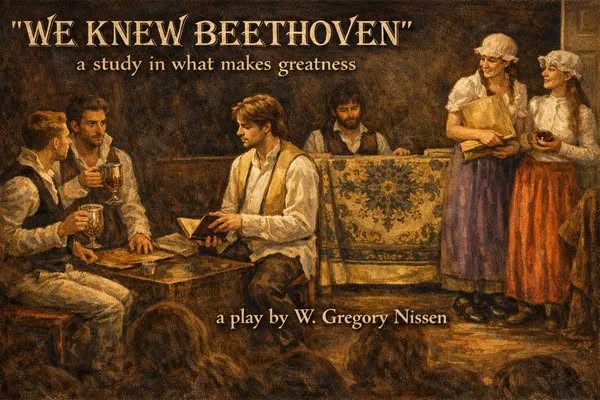
The most glaring failure of Nissan’s work is his imposition of 21st century political values on a boy and then man living in the late 18th and early 19th century. The Bonn of Beethoven’s youth was an Ecclesiastical Principality and the Beethoven family, both father and young Ludwig, were court musicians. Although it is certainly possible that Beethoven and others in Bonn society had a fascination with the American Revolution and its republican values and even more so with, at least initially, the French Revolution. It is doubtful that many of those friendly feelings toward republicanism survived Robespierre’s Reign of Terror or the Napoleonic Wars. It is even more unlikely that a strong republicanism would be reflected in the compositions of a man who owed his livelihood to the Austrian aristocracy under Emperor Francis. Yet, Nissan wants his Beethoven, influenced by some questionable American scholarship to reflect those values but offers no support for that rather bold idea.
Nissan also seems to have created the “friends” of young Beethoven. There certainly may be a lack of primary source material, but there must be contemporaries he had in Bonn who are actual historical figures that are likely to have interacted with Beethoven and created relationships that could have taken on more realism in this work. Instead, Nissan gives a surface view of a young genius who was fond of alcohol, full of himself and had disdain for anyone he considered below him. All of which may have been true, but Nissan provides no context.
The second act explores Beethoven’s life and tribulations while living in Vienna. What is strange about the second act is that Beethoven, who is prominent on stage in Act I, disappears in Act II after a brief appearance. Even stranger because there is probably much more source material about a musician was an important figure in Austrian society in the early 19th century. Nissan fails to establish any relationship between Act I and Act II and they feel like two separate plays.
Nissan, to this point in the development of We Knew Beethoven, has been unable to write a play that convinces the audience that his understanding Beethoven is so deep that he knows what motivates him. He needs to be able to make fictional scenes that reflect a possible reality for Beethoven’s relationships with his contemporaries and his sponsors. And, if he is going to keep Beethoven on stage in Act I, he needs to keep him on stage in Act II.

