

Richard Vetere’s Zaglada is an example of what every playwright should strive for. The playwright wrestles openly with major social and political issues without coming to a conclusion while being appalled by the abuse applied by what is supposed to be a loving parent.
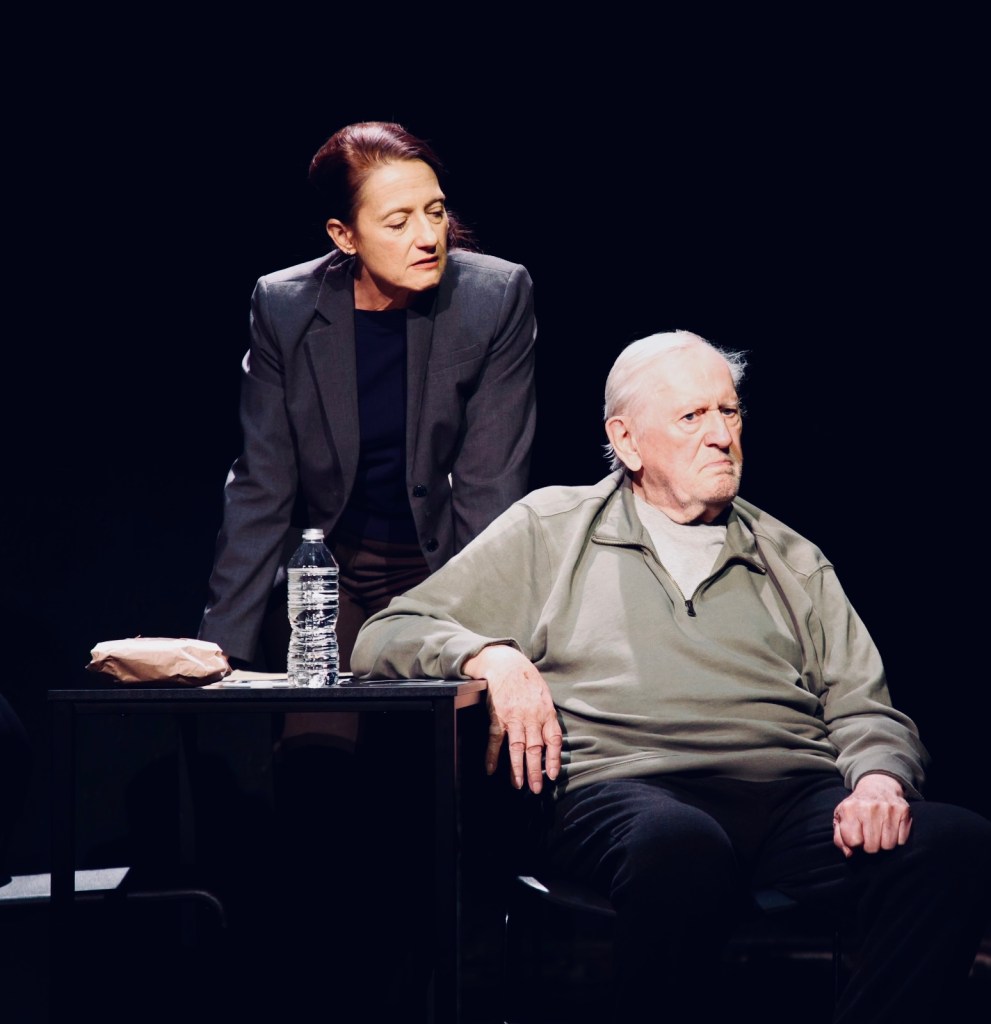
Len Cariou’s Jerzy Kozlowski is a 90-year-old Polish immigrant living in Queens with a wartime past that makes him a war criminal and a pre-wartime past that would have disqualified him from migrating to the US. Jen Washington’s Danielle Hooper is a reporter/PhD student who discovers his past and wants to interview him for her dissertation. When she comes to his door he shoots at her. What is not clear is whether the shot comes because she is Black or because she is a threat to his freedom. Because her subject is how Blacks, whether in Slavery or in prison, and concentration camp prisoners were both coopted by the system to inflict punishment on other prisoners either to get favors or extend their own lives and whether those individuals actually had the agency to reject the position she does not want to press to charges, but that is not an option in New York.
The next question is the debate between Hooper and Salatore Inverillo’s Frank Napoli, a high-ranking officer in NYC counter terrorism division, about her access to the prisoner and whether Kozlowski deserves consideration for his wat crimes because of his age. Enter Maja Wampuszyc’s Sonia Sokolow as a Homeland Security Agent who is of a single mind that Kozlowski needs to be deported and tried for his crimes. But the politics of the world have ch and she cannot find a government willing to accept him and try him. Germany, Poland and even Israel want nothing to do with trying a non-Nazi collaborator.
These debates about the need to hold someone responsible for their actions when they are coerced to perform them properly never reaches a conclusion in Vetere’s narrative.
What Vetere does reach a conclusion about is the relationship between Sokolow and her never on stage father. To those listening carefully, it is apparent that Sokolow’s father spent her entire life indoctrnating Sokolow with hatred for Kozlowski and the things he had her Jewish mother do while a prisoner in Buchenwald. What becomes apparent is that Kozlowski, a Catholic, and Sokolow’s father, a Jew, were both in love with Sokolow’s mother and both served as Kapos and had other prisoners killed to save the woman they loved. Sokolow’s mother eventually rejects Kozlowski, probably by force or intimidation to marry in faith. Sokolow’s mother commits suicide two months after Sokolow’s birth which her father blames on Kozlowski. This sequence eventually leads Sokolow to murder Kozlowski to protect her father from having his past as a war criminal and role in her mother’s suicide from being revealed. Child abuse does not receive a pass here.
The production’s simple set is all that it needs, but the placement of the props could have been better thought out. Wampuszyc does a good job moving her characters on stage and keeping the audience challenged. What was a little disappointing was that in what was the fourth show, actors still were not sure of their lines and from time to time stepped on each other. Those things should have been corrected this deep into a run.
All in all, though Zaglada should be a primary target for anyone who loves thinking theater.
 Showtones