

A Long Way from Home is the second entry in Anne L. Thompson Stretching’s trilogy The Blood Trilogy. It is another fine piece of writing by Thompson-Stretching and a very good production but lacks the social insight of the first entry, A Lesson on Blood. Set in Brooklyn, it seems that the Black family explored is a first-generation family moving to New York as part of the Great Migration. Somewhat confusingly and perhaps inexplicable, given that this is part of a trilogy, the play does not seem to be dealing with the same family we were introduced to in A Lesson in Blood and their Southern experiences, although traumatic, do not seem to be as devastating as we saw in A Lesson. If it is the same family, perhaps the shows needs to be seen in rep to be fully appreciated.

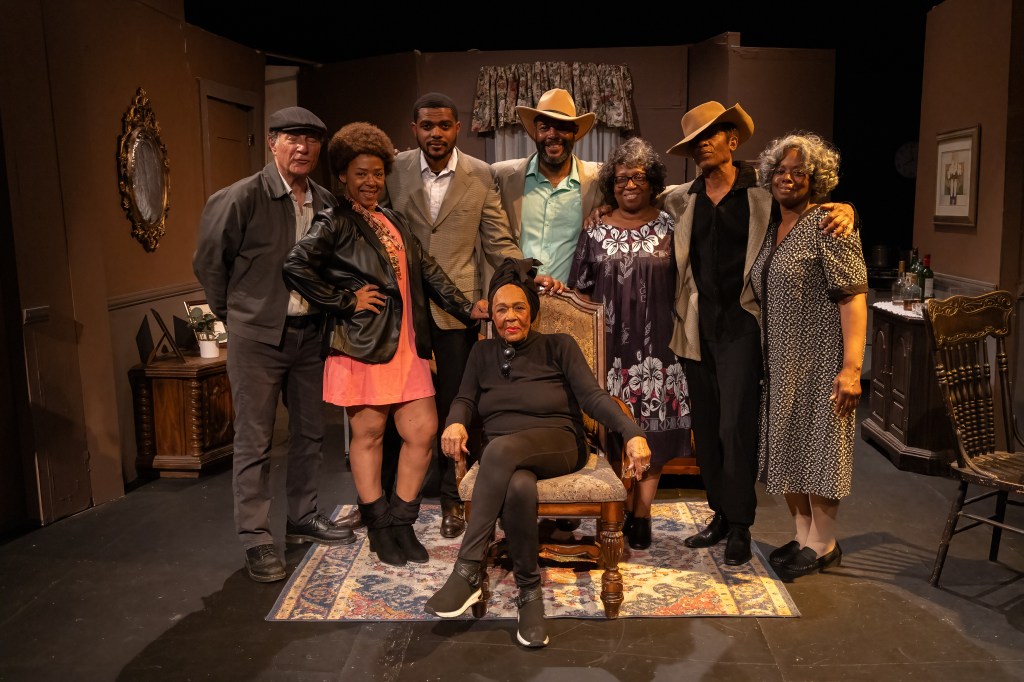
A Long Way from Home gives us insight into a completely dysfunctional mid-sixties Black family that stays together either for economic reasons or because they are “blood”. No other legitimate reason for their remaining a family unit is apparent. Shanna Taylor (Ms D) is the family matriarch who believes ALL family matters MUST remain private and unspoken. Problems must be pushed under the rug even when they threaten the ability of the family to survive. She remains with husband, Jacob Taylor (Kevin Leonard), despite his being a man who can’t hold a job, philanders, disappears, and mentally abuses her because “she loves him”. Ladaun Hailey plays the son, Willie Taylor, who believes that loyalty is more important than honesty and setting truth aside for the purpose of family “unity” and emulation of “dad” is the most important thing you can do. Joy Foster’s Lucille Taylor plays a young woman searching for a purpose, whether that is uniting with the Black Panthers or dating the white boss, Joe Falco, (played by Phil Oetiker) of Chester Taylor (Rommell Sermons) because he treats her with more respect than any Black man ever has. Chester is the uncle who puts moves on Shanna and sometimes acts inappropriately with Lucille while stealing from everyone to finance his “dream”. But even he is “forgiven” until he shows he is completely unrepentant.
Thompson-Stretching’s direction allows Ms D and Phil Oetiker to go completely over the top which keeps the play, despite its darkness, uncomfortably hilarious. She does miss the opportunity to make Chester a perpetuator of “block busting” which would give the play a much stronger social message. But she deserves credit for providing “Gilmanesque” dissection of a Black family showing all the warts and self-destructive tendencies.
The direction although fine when the actors are on stage, has several unnecessarily extra-long scene changes when the show goes to black instead of making the scene change smoother with more thought-out lighting.
The show is very entertaining, but as room, with minor changes for significant improvement and leaves us waiting for the third entry in the trilogy.
 Showtones