
Anne L. Thompson-Stretching’s A Lesson in Blood has some of the most unique writing seen in theater. She indulges in what might be called “hyper-realism”. Her language and scenes depict life for a poor black family in the 1946 rural South exactly as any student of the period would imagine it. This is both the strength and the weakness of the play. All characters, Black and White, engage in racism, anti-antisemitism, anti-Catholicism, and, yes, even anti-Caucasianism through their actions and language. The audience has to admire Thompson-Stretching’s brutal honesty, but the disgusting behavior and language of her characters is hard to listen to and watch.
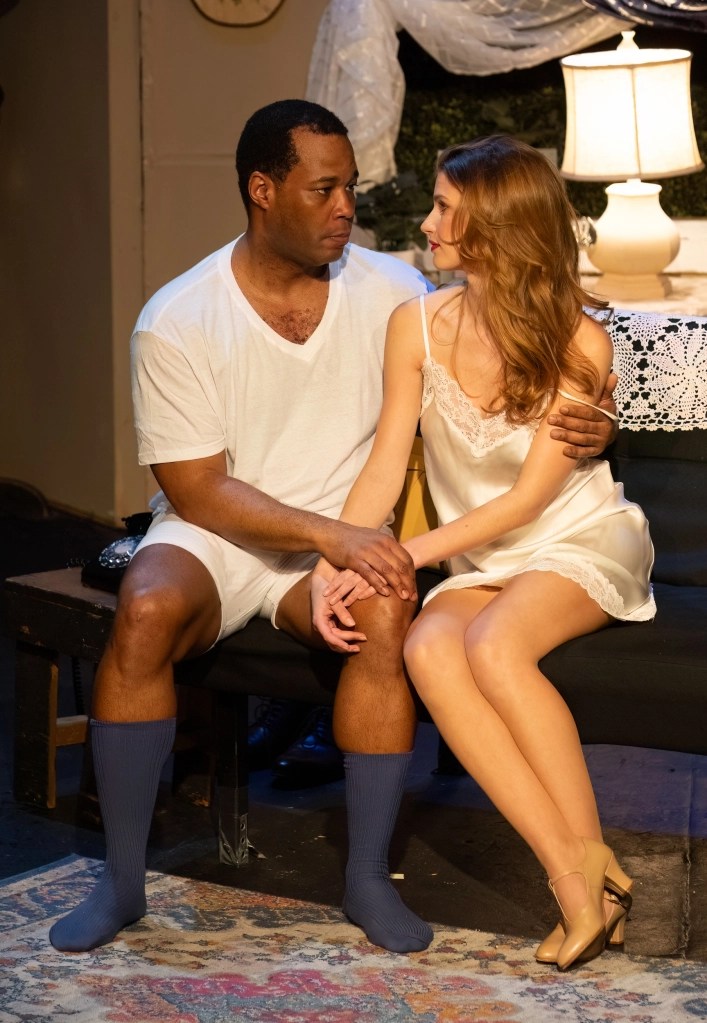
A Lesson has many plot lines, none of which are fully developed because none of the characters do any self reflection. This causes a bit of emptiness for the viewer who might pick and choose which plots they would like to see further developed. Personally, the treatment of Aggie and Clara, who are victimized once through rape and then by being “spoiled” goods, much like Titus’s daughter Lavina was, is something I wanted a deeper dive into. The multiple plot lines also obscure that “Aunt Lucy” is so obsessed with protecting her nephews, the last of the bloodline, that her “deep” Christianity takes a backseat as she accesses the services of a dark witch to destroy every threat to “her” boys. The town patriarch, Nathan, the racist Sheriff, Johnny, the wayward duaghter, Aggie, and the headstrong, possesive Clara all must die because of the various threats they represented for “her” boys. Thompson-Stretching could have written an entire play around Lucy misrepresenting who she was, how powerful she was, and what motivsted her evil acts.
Watching the South as it was, and in many ways still is, was a important journey to go on. But it is a difficult journey, not for everyone.
As for the production itself, Tippi’s direction and the placement of the actors on stage is very solid, but the constant and unnecessary going to black on scene changes is a bit amatuerish and leads to very questionable lighting decisions.
The raw, violent exploration of rural Southern culture make this “should see” a difficult night of theater.
 Showtones