
PART II: Roberto as an actor
A Bronx native and a graduate of Columbia University and Harvard University, I developed over two decades of experience in government policy, politics, and nonprofits. I shifted from research, analysis, and administration to my passion for the arts, as an actor, script writer/doctor, producer, and advocate. When I was a child watching TV or a film, I would ask myself sometimes, why did the actor deliver that particular line that way; why did the writer write that particular sentence that way; why was this or that plot or character choice made by a writer or executed a particular way by that director. I was discerning what I would do differently. Even though I took liberal arts and humanities courses in college, the idea of studying acting was out of sight out of mind. I first took workshops with an acting teacher, the late Arthur Reel of the Arthur Reel Studio, with the goal of improving my ability to assert a point of view and connect with people when having a conversation. However, because Mr. Reel also taught a course, “Acting for Non-Actors,” my acting evolved from the crucible of a classroom, to the performance of a full scene on stage, to an entire play on stage – with me as Felix and Art Bernal as Oscar in The Odd Couple; to performing in other plays as the lead, (Faust, The Tangled Skirt, A Cop Shot My Son; Dine and Dash) – including the lead in a musical, singing four songs (Joy and Complete Chaos); to performing the lead in plays I wrote (Bromance-A-Roni, Five Consecutive Zeros, The Final Covenant of Vito Marcantonio). I have played lead and supporting roles on stage and screen in dramas along with improvisational, sketch, satirical, musical, rant, and mockumentary comedies. I had devoted a fuller time focus to theatre beginning in 2013 and then to screen acting in 2017. While I performed a range of roles and personalities, a few personality types tended to emerge, including the “mentor” role – who provides guidance or insights to the main protagonist; the loveable and unlovable jerk; the cautious and neurotic type as well as the bombastic, temperamental, impulsive type who fails to do their due diligence.

Share with us your onstage creative process.
Generally speaking, the repetition process helps me to draw out the definitive way a line should be delivered, as well as helping to inculcate and reinforce the lines into my memory. I may directly recall a relevant prior experience, but more likely I will intuitively and instinctively reflect on the essence of relevant experiences buried somewhere inside me. An acquaintance from Australia once observed that language itself can shape a style of deliver more so than the other acting approaches. I initially thought this might be true for plays where language style has emphasis, such as with Shakespeare. The gentleman’s observations resonated in the long-term. Just as when you act in a period piece, and the clothes help transform your posture into someone from that era, language helps to shape the personality of my character and his line delivery style. Past conscious or unconscious experiences may help me determine the pace, volume, and cadences of that line delivery. In terms of my creative process performing the role of Vito Marcantonio, the three most helpful elements were watching video footage and listening to radio footage of his voice along with acting in a play, The Tangled Skirt, also directed by Art Bernal. In The Tangled Skirt, there were only two characters, the femme fatale and the mystery-suspense writer / gumshoe-wannabe-detective played by me. The playwright appeared not to specifically set the story in the 1940s, but the characters have a 1940s repartee in their dialogue. This experience – not to mention my enjoyment of the films set in that era – helped me create the subtext/mindset and muscle memory to portray Marcantonio. To the extent that Vito Marcantonio saw his constituents face to face helping them overcome their daily struggles (as initially explained by my college friend to me – see answer to other question), so his constituents would, in turn, back him up thick and thin when he would take controversial stands on issues for civil rights or against the Truman Doctrine. So, I thought of The Godfather, and it was helpful to observe the Don Corleone character (who ostensibly was a re-purposing of the essence of Mario Puzo’s mother when Puzo’s The Fortunate Pilgrim initially failed as a novel). The New York Times quotes me in an interview prior to a Centennial Celebration of Vito Marcantonio in 2002 at the Museum for the City of New York as saying: ”He made himself accessible to people regardless of race, creed, or color: Black, Hispanic, Italian, Jewish. He’s essentially the good Godfather, the antithesis of Vito Corleone. His story shows how ‘The Godfather’ is actually the bizarro world of the real Italian-American experience.” A childhood imagination among Italian-American youth who were my contemporary back then was to be a character in the Godfather, or to be Marlon Brando, Robert DeNiro, or Al Pacino. My adult aspiration became to portray a personage and hero (and anti-hero) who was everything you liked about Don Corleone, but on the right side of the law. To the extent that Al Pacino is a model for acting, partly because of his love for theatre, including Shakespearean theatre, and film. I get to be what he almost got to be: He was supposed to portray Vito Marcantonio in 1988 in a project that did not proceed. However, he is quoted as having used Vito Marcantonio as part of his subtext in his role as the Mayor in the film, City Hall, released in 1996.
What drew you to this play?
The reasons that drew me to this play and subject matter as an actor are the same or similar to what drew me as a writer. The writer and actor in me are one in the same in terms of the attraction to the topic of Vito Marcantonio. This includes the series of coincidences since 1986 where Marcantonio kept recurring in my life to the point that I felt compelled to showcase knowledge about him in an academic and scholarly setting and then – prompted by a mentor’s idea -in an artistic setting. The topic of Vito Marcantonio has come to feel like a calling – or perhaps, THE CALLING – for my life. The writing of any of my scripts on Vito Marcantonio and a non-negotiable conviction to portray him feels like a higher purpose in life and a personal mission.
Do you feel an extra added responsibility when doing a show with such serious subject matter – AND about a real-life individual?
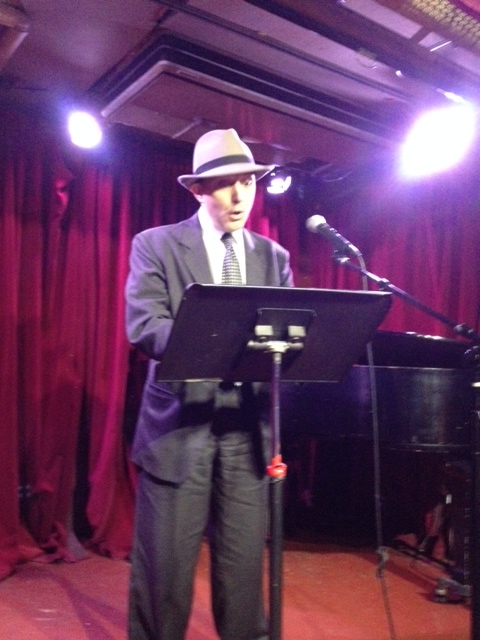
Any actor probably feels the pressure of doing justice to a serious subject matter, and the pressure is compounded when trying to portray a historical figure who lived through a rather dramatic biography. In the case of Congressman Vito Marcantonio, the additional pressure comes from not only showcasing an unknown historical figure, but one who is an unsung hero for his previously buried accomplishments – achievements that have transcendent and remain relevant today – even as many people continue to be unfamiliar with him, including the “underdog” demographic groups for which he advocated. When discussed in academic and community development settings, Marcantonio elevates the enthusiasm of people who learn about him. People seem fascinated and excited that such a person actually existed in politics. For example, by coincidence, when African Americans whom I’ve befriended learned about Marcantonio through me, with outrage, they exclaim, “how come I’ve never heard of this guy.” Two interpretations as to what they meant by this observation: “why hasn’t Marcantonio become a topic of common knowledge within the African American community…and in mainstream education.” Marcantonio’s story fosters a collaborative spirit and energy to participate in the shared experience of learning of his life and work. I recall a few instances when the Vito Marcantonio Forum took up a collection for the work it was doing. A gentlemen donated $20 to the group at the beginning of the event. Then, at the end of the event, having learned more about the sacrifices Marcantonio made for everyday people and what he was put through by the Establishment, he pulled another $40 out of his pocket and gave it to the organization. People can develop such a visceral connection and commitment to Vito Marcantonio in such a short time. Thus, it’s so important an audience feel inspired, motivated, and perhaps even activated into peaceful advocacy by the actor’s portrayal of Marcantonio.
What kind of extra pressure do you feel being alone on stage?
I don’t feel uncomfortable giving a speech before a large audience or serving as an emcee. The extra pressure comes from not just having to be properly memorized, particularly since one can also drop a line because there is no other character on stage queuing the next line or action. Moreover, when a person carries out the blocking in this play, the transitions, and thus, the blocking can potentially throw the actor off. The most definitive pressure comes from having performed the one-man show once in January 2019 for an invitation-only, industry-professional performance before a full house and receiving a standing ovation. How does one exceed that in an 11-day Off-Broadway run? The only other closest thing to portraying a one-man show besides the prior one-day performance of the full show and the REaP the Art production of the 20-minute version over several days is my performance in The Tangled Shirt. As mentioned, there are only two characters in the play – the femme fatale and the mystery-suspense writer / gumshoe-wannabe-detective played by me. The characters have a 1940s repartee in their dialogue. This experience – not to mention my enjoyment of the films set in that era – helped me create the subtext/mindset and muscle memory to portray Marcantonio. The challenge for The Tangled Skirt was memorizing three or four major monologues and parts of conversations that were nonlinear, meaning one line response did not logically follow what was previously said Therefore, an actor could potentially become confused, losing their place in the play, and jumping lines. Thus, with a one-person show, one might avoid the pitfalls of being inaccurately queued by another person or the potentially confusing traps in the script itself. The trade-off in doing the one-man show, however, is having to rely on yourself to remember everything, including the logic of one’s performance, including the nonlinear, nonmethodical, nonchronological moments. In my case, the pressure is somewhat abated when I portray a character in any script I myself have written (with many characters or with just the one-man show). I will have instilled what I have written in my memory as I write, re-read, and edit, even prior to a rehearsal. Moreover, because my writing is based on an experience or inspiration that led me to commit a script to paper, the actor having shared the same experience with the writer – since we are one and the same – is a beneficiary of that immersion and instillation. So, then it’s a matter of making the time to memorize it through repetition and even test one’s ability to perform some random portion of the script beyond the beginning to test one’s memory of where the story goes from that point on. In other words, with respect to The Purgatory Trial of Vito Marcantonio, because I authored the piece, even though I am performing it, the writer in me controlled the logical flow of the story: the linear, and the nonlinear, the chronological and the non-chronological, the methodical and the unmethodical. And the script becomes reinforced in my mind with every writing or editing, repeated silently or out loud, which helps the script become a part of me. The other challenge is what balance of food and drink one wants to have during the day, leading up to the performance that leaves your mind clear and your body balanced and sustained to perform an entire show, not to mention two shows on a Saturday.
What’s next for you?
There was a freedom and catharsis in learning that I enjoy writing dialogue-driven stories. There is a particular joy in writing comedies that combine real-life experiences or history and humor that also incorporates cultural literacy. Writing a full-length script as far back as 2015-2016 about Vito Marcantonio as my only serious drama and magnum opus project was a “North Star” in a universe of comedic scripts that I generally prefer to write. Taken together, my scripts provided the epiphany that I would prefer to write scripts as a work to be produced and to cast myself as one of the characters (and play a role in production where needed) rather than audition for other people. Besides pursuing the Vito Marcantonio story further, I am reviewing the over 20 scripts I have written or are in different stages of completion. While I work on completing the incomplete scripts, I would like to pursue getting the completed scripts produced on stage or on film with myself as one of the characters. With respect to the topic of Vito Marcantonio, I would like to take ownership in a way similar to how Sylvester Stallone felt an ownership towards Rocky and Chazz Palminteri felt an ownership towards Bronx Tale for the benefit of public knowledge, entertainment, along with intellectual, cultural, and spiritual knowledge and wisdom.
WORK OF ART PRODUCTIONS, LLC presents a new play written and starring Roberto Ragone
THE PURGATORY TRIAL OF VITO MARCANTONIO
Directed by Art Bernal
October 4 – 15
The Sargent Theatre
of the American Theatre of Actors arts complex
314 W. 54th Street (Fourth Floor)
WED 10/04 8pm — THUR 10/05 8pm — FRI 10/06 8pm
SAT 10/07 3pm & 8pm — SUN 10/08 3pm
TUE 10/10 8pm — WED 10/11 8pm — THUR 10/12 8pm — FRI 10/13 8pm SAT 10/14 3pm & 8pm — SUN 10/15 3pm
 Showtones